
Realistic Resilience Methodology
How we build resilience programs around how organizations actually behave during disruptions — not how textbooks say they should.
This methodology was developed through 15+ years of building and managing BC/DR programs at major financial institutions, leading crisis response as VP of Crisis Management at Bank OZK, and consulting across multiple sectors.
It's based on what actually works during real disruptions — not what looks good in a compliance audit.
The Problem with Traditional Resilience
Most resilience consulting follows a predictable pattern:
- Conduct a Business Impact Analysis (BIA)
- Write recovery plans based on RTOs and RPOs
- Run a tabletop exercise
- Hand over a binder
- Declare victory
The plans look professional. They pass audits. And they sit untouched until the next audit cycle.
Why? Because they're built for auditors, not responders. They assume organizations behave rationally during crises. They treat recovery as a linear process that follows documented procedures.
Reality is messier.
What is Realistic Resilience?
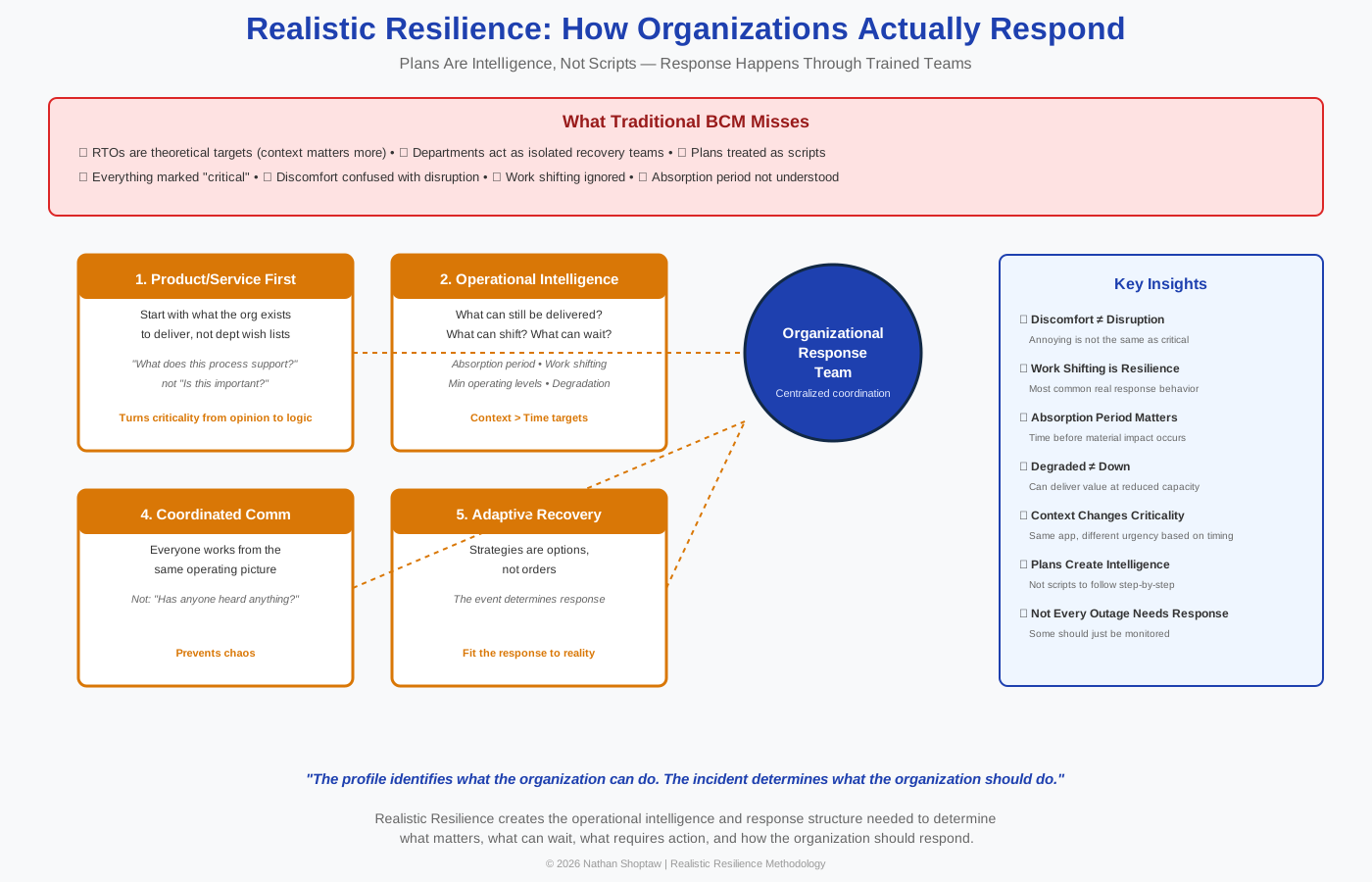
Realistic Resilience is a planning and response methodology built around a more honest view of how organizations behave during disruption. It is communication-, intelligence-, and decision-centered, not document-centered.
The RTO Illusion
Traditional BCM says: "This application has a 24-hour RTO."
Reality says: "It depends on when it goes down and what work people were doing."
Example: An application goes down Monday morning. IT panics because it has a 24-hour RTO. Leadership demands immediate restoration. But the departments that use it? They shift to other work and don't really care it's down. The real tolerance might be days.
Flip scenario: Same application goes down during month-end close. Now the tolerance is hours, not days — regardless of what the documented RTO says.
This is why RTOs are theoretical targets, not operational reality. Realistic Resilience focuses on what the organization can actually still deliver during disruption, not arbitrary time targets.
Minimum Operating Levels vs. Full Restoration
Traditional BCM says: "We need all 10 employees back to resume operations."
Realistic Resilience asks: "What's the minimum we need to keep operating?"
Example: A pandemic hits and all 10 employees in a department are sick. Traditional planning says you're down until everyone returns. Reality? You might only need 1-2 people back to perform the most critical functions nominally.
The key insight: Organizations can deliver value at degraded capacity. Maybe it's slower processing, reduced hours, limited services, or manual workarounds. But "degraded" is not the same as "down."
Realistic Resilience identifies what percentage of capability you actually need to continue operations — not just when you can return to 100%.
Work Shifting: The Most Common Real Resilience Behavior
Traditional BCM focuses on recovery strategies and workarounds. But the most common real-world response to disruption is simpler: people shift work.
When an application goes down, employees don't sit idle. They:
- Answer email and catch up on administrative tasks
- Attend meetings and make phone calls
- Process items that don't require the unavailable system
- Prepare work for later entry when the system returns
- Support other teams or clean up backlog
This is resilience. It preserves productivity, reduces panic, buys time, and may prevent unnecessary activation of formal workarounds.
A department that can shift work for 4 hours doesn't need the same recovery urgency as one that immediately loses customer-facing capability.
The Absorption Period: Time Before Material Impact
Most dependency failures don't cause immediate material harm. There's an absorption period — the time between failure and actual business impact.
Example: An internal reporting tool goes down at 9 AM. Employees are frustrated. Work slows. But if the reports aren't due until tomorrow and people can shift to other tasks, the absorption period might be several hours or even a full business day.
Change the context: Same tool goes down 2 hours before quarter-end financial reporting is due. The absorption period collapses to near zero.
Understanding absorption periods prevents overreaction. Not every outage requires immediate crisis response. Some should simply be monitored while IT works on restoration.
Discomfort Is Not the Same as Disruption
Organizations often confuse discomfort with material business impact.
Discomfort is real: people get frustrated, work slows, managers get irritated, productivity takes a hit.
But discomfort is not always material impact. If employees can shift to other productive work and no core product, service, customer commitment, regulatory obligation, or revenue stream is affected, the organization may not need formal response activation.
The hard question: "Is this actually hurting the organization, or is it mainly annoying the department?"
The response should match the real impact. Annoying ≠ Critical. Inconvenient ≠ Material. Delayed ≠ Failed. Slower ≠ Stopped.
The operating cycle is simple:
- Understand the business
- Connect the information
- Validate capability
- Train the response team
- Communicate direction
- Coordinate recovery
- Learn and update
The Five Pillars
1. Product/Service Alignment
Traditional approach: Start with a BIA that maps every process, system, and dependency.
Our approach: Start with what the organization exists to deliver, then map processes and dependencies underneath.
Why it matters: Most organizations can't articulate what they actually do in simple terms. If you can't explain what must stay up, you can't build a meaningful recovery strategy.
How we do it:
- Identify the 3-5 core products or services that generate revenue
- Map the critical processes that deliver those products/services
- Identify dependencies (people, systems, vendors, facilities)
- Define what "operational" actually means for each service
2. Operational Intelligence
Traditional approach: Document everything in recovery plans and hope people remember where to find it.
Our approach: Build the structured information response teams need to understand disruption and make decisions.
Why it matters: During a crisis, people need answers fast: Who's impacted? What systems are down? What's the priority? Where's the data? Traditional plans bury this information in 50-page documents.
How we do it:
- Create dependency maps that show what connects to what
- Build decision trees for common scenarios
- Document contact information, escalation paths, and vendor SLAs
- Make information accessible (not buried in SharePoint)
3. Organizational Response
Traditional approach: Assign recovery responsibilities to individual departments and hope they coordinate.
Our approach: Coordinate response through a trained, cross-functional team rather than isolated departmental recovery actions.
Why it matters: Most disruptions impact multiple departments. If IT, Operations, and Communications aren't talking to each other, recovery is chaotic.
How we do it:
- Define a crisis response team structure (not just "the IT team")
- Assign roles based on actual decision-making authority (not org chart titles)
- Create communication protocols between teams
- Train the team to work together under pressure
4. Coordinated Communication
Traditional approach: Write communication templates and hope someone remembers to use them.
Our approach: Define communication paths before, during, and after disruption so everyone works from the same picture.
Why it matters: Most crisis failures are communication failures. People don't know what's happening, who's in charge, or what they should do.
How we do it:
- Map communication flows (who needs to know what, when)
- Define notification triggers and escalation thresholds
- Create simple, usable communication templates
- Establish regular update cadences during incidents
5. Adaptive Recovery
Traditional approach: Document detailed recovery procedures and expect people to follow them step-by-step.
Our approach: Treat documented strategies as options, not orders. The actual event determines what should and should not be activated.
Why it matters: No two disruptions are the same. A plan that works for a power outage won't work for ransomware. Response teams need options, not scripts.
How we do it:
- Document recovery strategies as decision points, not checklists
- Train teams to assess situations and choose appropriate responses
- Build flexibility into recovery plans
- Focus on principles and decision-making, not rigid procedures
How We Adapt to Different Frameworks
Realistic Resilience is our methodology, but we're not dogmatic about it. Organizations have different regulatory requirements, cultures, and starting points.
We have deep experience working inside:
- ISO 22301: Business Continuity Management Systems
- NIST CSF: Cybersecurity Framework (Identify, Protect, Detect, Respond, Recover)
- FFIEC: Financial services resilience requirements
- DORA: Digital Operational Resilience Act (EU)
- SOC 2 Type II: Service Organization Controls
- Adaptive BC: Adaptive business continuity methodology
- Unified Resilience: Unified resilience framework
We use the framework that fits your needs, not the one that's easiest to sell.
Our Technical Approach
Business Impact Analysis (BIA)
What we do differently:
- Start with products/services, not processes
- Focus on what actually matters (not every process in the company)
- Define impact in business terms (revenue, reputation, regulatory) not just RTOs
- Validate findings with leadership before documenting
Dependency Mapping
What we do differently:
- Map dependencies visually (not just in spreadsheets)
- Identify concentration risk (single points of failure)
- Focus on critical paths, not exhaustive documentation
- Make maps usable during actual incidents
Recovery Strategy Development
What we do differently:
- Design strategies around your constraints (budget, staff, technology)
- Prioritize workarounds over perfect solutions
- Test feasibility before documenting
- Build options, not mandates
Crisis Management Structure
What we do differently:
- Design around your actual leadership culture (not generic ICS models)
- Assign roles based on decision-making authority, not titles
- Keep teams small and focused
- Train for real scenarios, not theoretical exercises
Testing & Validation
What we do differently:
- Test to find gaps, not to check boxes
- Use realistic scenarios (not "the building is on fire")
- Focus on decision-making and communication, not procedure recitation
- Debrief honestly and update plans immediately
Tools & Platforms
We're consultants first, software builders second. We only recommend our applications when they're the right fit for your needs. We regularly work with clients using ServiceNow, Fusion, Castellan, and other platforms.
Platforms we work with:
- GRC Platforms: ServiceNow, Fusion Risk Management, Castellan, LogicManager
- Collaboration: Microsoft Teams, Slack, SharePoint, Confluence
- Notification: Everbridge, OnSolve, AlertMedia, custom solutions
- Our Tools: Resilience Planner 360, Navigator, CrisisForge (when appropriate)
What You Can Expect
When you work with us, you get:
- Honest assessment: We'll tell you what you need, not what maximizes our revenue
- Practical solutions: Programs built for your reality, not textbook ideals
- Tested capabilities: Everything we build gets validated through exercises
- Trained teams: Your people will know how to execute, not just read plans
- Transparent pricing: No inflated day rates or surprise fees
- Ongoing support: Available when you need us (BCaaS model)
Ready to Build a Program That Actually Works?
Book a free 30-minute call. We'll talk through where you are today, where you need to be, and whether our methodology is the right fit for your organization.
Schedule a discovery call